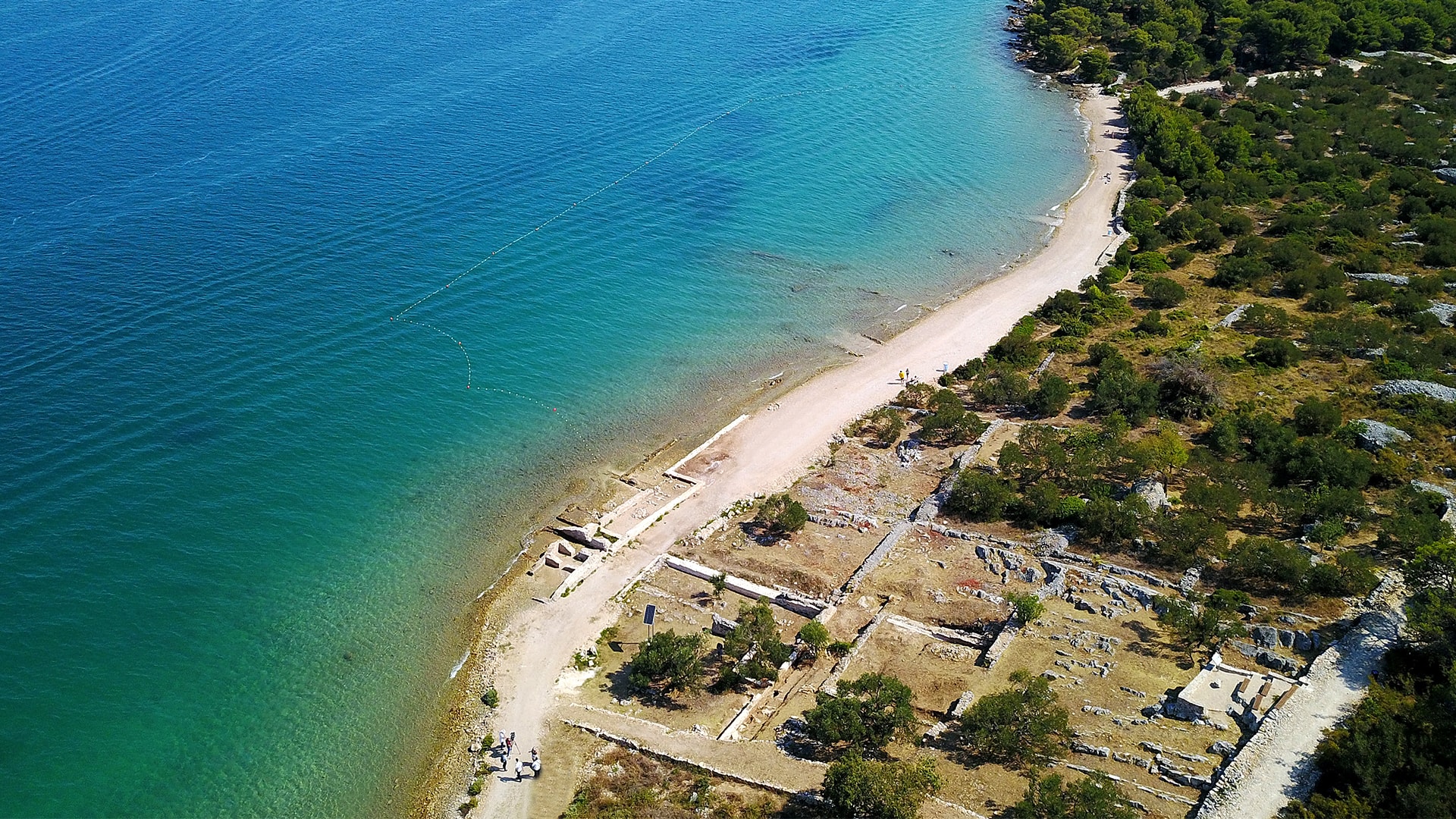
From Luka Jelić's first excavations in 1907 to today's underwater research — more than a century of discovering Colentum.
1907Year
1907/1908 – Luka Jelić
The first research was carried out next to the remains of the ancient cistern (the so-called “tamnica”, or dungeon), which are still clearly visible today. Remains of architecture, columns and architraves were found, as well as a dozen decorated stone fragments and two fragments each of sculpture and inscriptions.
Read moreShow less
Coins were also found (e.g. from the time of Nero and Vespasian), as well as fragments of tegulae with stamps (SOLONAS and PANSIANA / TI. PANSIANA). The research was carried out sporadically, mostly by recording what local people had dug up and/or found – for example, J. Šikić uncovered paving slabs at a depth of 1.5 m on plot 4517/3, and J. Jadrešić, known as Bajok, found a golden angel about 15 cm tall.
1966Year
1966–1973 – Duje Rendić Miočević and Aleksandra Faber
Almost six decades later, the first systematic archaeological research began, lasting several years with occasional interruptions.
Read moreShow less
Mainly the results relating to architectural and urban remains were published, while the small archaeological finds (pottery, glass, etc.) have not yet been published. In total, 16 architectural complexes were defined (some of whose walls continued under the sea) and at least one town street.
1984Year
Šibenik City Museum – Ivan Pedišić
1985Year
South of the “tamnica”
In 1985 another research campaign was undertaken, though on a much smaller scale, south of the “tamnica”, and its results have so far only been published preliminarily. A large bathtub reached by a single step was discovered, and the area in front of the tub was covered with a mosaic of white tesserae with a black border. A grave and the remains of a sewage system were also found.
2008Year
Rescue excavations – Toni Brajković
After it was learned that the company Vipnet intended to install an antenna transmitter within the Gradina archaeological zone on Murter, rescue trial-trench excavations were carried out on land plot 4571/316 from 16 September to 22 October 2008.
Read moreShow less
The research was led by Toni Brajković, MA, curator of the ancient collection of the Archaeological Department of the Šibenik City Museum. Based on the variety of materials found, it was concluded that this site within the hillfort settlement also showed continuity from prehistory to the Roman period.
2012Year
The largest research in half a century – Željko Krnčević and Irena Radić Rossi
Under the leadership of archaeologist Željko Krnčević of the Šibenik City Museum, the largest research of the last half century was carried out. The extensive archaeological work yielded exceptional results.
Read moreShow less
Work focused on the villa by the sea, until then known as the “maritime” villa. The research established that it was a large building with several phases, used from antiquity, i.e. from around the 1st century, until the 5th and 6th centuries, and possibly even in the Middle Ages. The villa was found to extend over an area almost a hundred metres long, while its width is impossible to determine for now because it lies underground. However, from what is visible, it is at least 25 metres. Some of the rooms even had mosaics. Many pottery fragments and roof tiles were found.
In the underwater part of the camp, students of the Department of Archaeology of the University of Zadar, under the expert guidance of Prof. Irena Radić Rossi, PhD, systematically surveyed the area along the western coast of Gradina and towards Hramina marina. Important insights were gained into the ancient port of Colentum. It lay on the northern side of Gradina and offered ancient sailors shelter, especially from the south wind.
In front of a small cove before the outermost cape of the bay, many elements of a wooden structure were spotted that could be an ancient wooden jetty. These are vertically driven stakes and piles (wooden posts) and horizontally laid beams. The research also confirmed earlier reports of wall remains and piles of ballast stones. A large number of amphora stoppers, various amphora fragments and pottery vessels were also discovered. Notable finds include cannonballs and an almost complete ceramic oil lamp.
2012Furthermore
Argonauta Association, Šibenik City Museum and the Municipality of Murter-Kornati
Every year, research, projects and activities aim to contribute to the protection and valorisation of the Colentum archaeological site. The Argonauta association, in cooperation with the Šibenik City Museum and the Municipality of Murter-Kornati, invests in research at the site and in the conservation of its individual elements.
Read moreShow less
In addition to supervising the site, the Šibenik City Museum provides experts in archaeology and conservation. The museum's experts lead the research and coordinate work during volunteer and other campaigns to ensure that the site is managed properly.
Research was carried out in the area of the maritime villa and along the walls inside the villa up to the Liburnian rampart. Significant research was carried out during a 15-day archaeological campaign in the area of the Roman maritime villa.
During the campaign, about ten new walls were uncovered, cleaned and documented, most of them running perpendicular to the shoreline, apart from two already known walls that were traced along their full length and run parallel to it. These discoveries showed that the villa is much longer than initially thought and extends towards Cape Gradina. In terms of size it is not among the largest villas explored on the Istrian and Dalmatian coast, but its position makes it extremely interesting.
Because of its position, the villa belongs to the group of maritime villas located right on the seashore. Such villas do not have a central peristyle and are mostly elongated in design, with porticoes that open the villa towards the sea and make the whole complex easy to move through. Like other villas, it combines a residential and a working part. In maritime villas such as the one on Murter we can expect many more rooms used as storerooms, with a larger part allocated as a harbour pier for mooring ships, which reflects the effort to make use of a suitable stretch of coast inside a bay sheltered by many small islets.
The residential part can be expected in the section of the villa explored so far that is closer to the local cemetery. Many tesserae – the small stone cubes that made up Roman mosaics – were found in this part of the villa. Decorating floors and sometimes walls with mosaics was typical of triclinia, peristyles and other rooms for receiving guests. In storerooms and workshops we can expect floors of mortar and broken pieces of brick forming a kind of terrazzo. Unfortunately, no mosaic floor has been preserved in situ, but the frequency of tesserae in certain parts of the villa undoubtedly confirms this type of decoration. The tesserae are almost exclusively black and white, which suggests simpler two-colour mosaics with geometric ornaments such as meanders. Besides tesserae, many fragments of marble slabs were found. Whether they were set into mosaics, as was common practice, is currently impossible to say.
Particularly interesting is the apse, which today lies below sea level for most of the year. In the earlier imperial period, its shape often indicates a bath complex, which was almost indispensable in the villas of wealthy Romans. Near the apse, suspensurae were also found – cylindrical ceramic pillars that were part of the hypocaust, the Roman combination of underfloor and central heating. A large number of pottery fragments with typical parallel grooves most probably belong to tubuli, hollow ceramic pipes that carried warm air from the hypocaust to the rooms.
By contrast, finds of everyday kitchen, wine and other pottery are very scarce. This is largely due to the relentless effect of the sea and stones, which break, round off and crumble thinner, finer pieces of pottery. Much thicker pieces of Roman roof tiles – tegulae and imbrices – and amphora bases have better withstood the sea. One pottery fragment bears the stamp PANS[IANA], indicating that the tile was produced in the workshops of Vibius Pansa south of the river Po. This tegula fragment also gives an upper date for the villa, because tiles with this stamp were made until the time of Vespasian at the latest.
The newly explored part of the maritime villa is not rich in tesserae, marble slabs or tubuli. Larger pieces of amphorae and ballast stones predominate here. The pieces of broken amphorae were probably thrown out of ships after they had moored at the harbour pier of the Murter villa. The ballast stones are an interesting find that bears witness to Roman seafaring techniques – an empty ship, i.e. one that had unloaded its cargo, was filled with stones for better loading and balance, a problem we solve today with ballast tanks filled with water.
2019To the present day
Arheo KO-OP cooperative – Eva Buća and Tomislav Zojčeski
The results of the archaeological research of Colentum were presented to the public on 3 December 2019 at the Murter Public Library and Reading Room. The results of the research, carried out by the Arheo KO-OP cooperative, were presented by archaeologists Eva Buća, MA, and Tomislav Zojčeski, MA, the director of the Šibenik City Museum Željko Krnčević, MSc, and senior curator of the Šibenik City Museum Toni Brajković, MA.
Read moreShow less
The investor, the Municipality of Murter-Kornati, secured the necessary funds through the 2014–2020 Interreg V-A Italy – Croatia CBC Programme, Call for proposal 2017 Standard – HISTORIC, Priority Axis: Environment and cultural heritage, project: HISTORIC – Heritage for Innovative and Sustainable Tourist Regions in Italy and Croatia. The total value of the project is approximately HRK 18 million, of which approximately HRK 3.5 million belongs to the Municipality of Murter-Kornati.
While researching an area of 1,100 m², unusual because of its location in the tidal zone and in unfavourable winter conditions in January and February, the archaeologists did not even remotely expect the density of finds they discovered.
The position of Gradina is in fact the position of a settlement that originated in prehistoric times and then developed into a small town in the Roman period. We first reconstructed the Roman-era shoreline and made a high-precision orthomosaic showing the stone collapse of harbour piers 20 metres long and 5 metres wide. There is also evidence of a smaller pier that encloses everything into a small harbour, and more walls to the north, so it is clear that the sea and land finds are inseparable. Using stratigraphy we divided the walls into several phases, because this site did not come into being all at once – it was a long-term process. The sea level was lowered by 1.6 metres, which is how much the sea is assumed to have shifted since the Roman period, through the sinking of the coast and the rise of the sea.
— Tomislav Zojčeski, archaeologist
Although, based on previous knowledge, this somewhat pioneering undertaking – unusual because the archaeological site is submerged, not only in Croatian but also in world terms – was expected to bring new insights, the results were surprising to say the least:
All the finds belong to the Roman period. 22 masonry structures were found – walls, column bases, plastered floor structures, a large number of multicoloured stone tesserae (black, white, red, green), various kinds of stone, marble and marble tiles, and frescoes from walls and ceilings. Besides fragments of pottery vessels and building material, a surprise were the coins from the reigns of Tiberius and Caligula, 1st-century emperors. Analyses of the stone finds carried out at the Faculty of Science in Zagreb showed that the green stone comes from the Sinj area and the sand in the frescoes from Vransko Lake, which points to trade routes and links with these areas. One of the greatest insights is that a very rich, flourishing and prosperous settlement of the 1st and 2nd centuries stood here, whose wealth was based on maritime trade. The research disproved the existence of a maritime villa and confirmed the existence of a harbour facility. The walls found show that along the sea and in the sea, besides harbour piers up to 100–200 m long, there were also workshops, public spaces and storehouses by the port, which points to a rich harbour complex.
— Eva Buća, project leader
Representatives of the Municipality of Murter-Kornati, mayor Toni Turčinov and Luka Ježina, head of the municipal Department of Finance, Development and Economy, pointed out that the archaeological research and conservation work carried out was worth around HRK 1 million. This is the largest archaeological and conservation work in the history of this valuable archaeological site.
It was planned that at the beginning of 2020 the immovable finds would be fully conserved, followed by the construction of an archaeological promenade consisting of a land and a sea section, as a new competitive tourist product for Murter. Under the sea there will be an “amphora plantation” – two large illuminated cages measuring 8 × 3 metres with replicas of amphorae that will mature there and then become exhibits and items for sale in the Amphorarium. The estimated value of the Amphorarium is approximately HRK 12 million, and it is planned to be financed from EU funds. The educational sea and land trail will be equipped with lighting and information boards, with extensive use of augmented and virtual reality technology with 3D reconstructions, an authentic play and presentations, using virtual reality glasses.
This site, which dates back to turbulent prehistory and is largely submerged, was saved at the last moment from complete destruction and disappearance precisely thanks to this engagement of experts – the representatives of the profession and the local authorities agreed.
Cookies and external content
This website uses only necessary cookies. Interactive maps (Google Maps) and video (YouTube) load only with your consent, because these services may set their own cookies.
Cookie Policy