Explore the Site

Stari pisci o Colentumu

Discover Colentum – a town that still hides its secrets between stone and sea.

Colentum

Where history rises from the sea

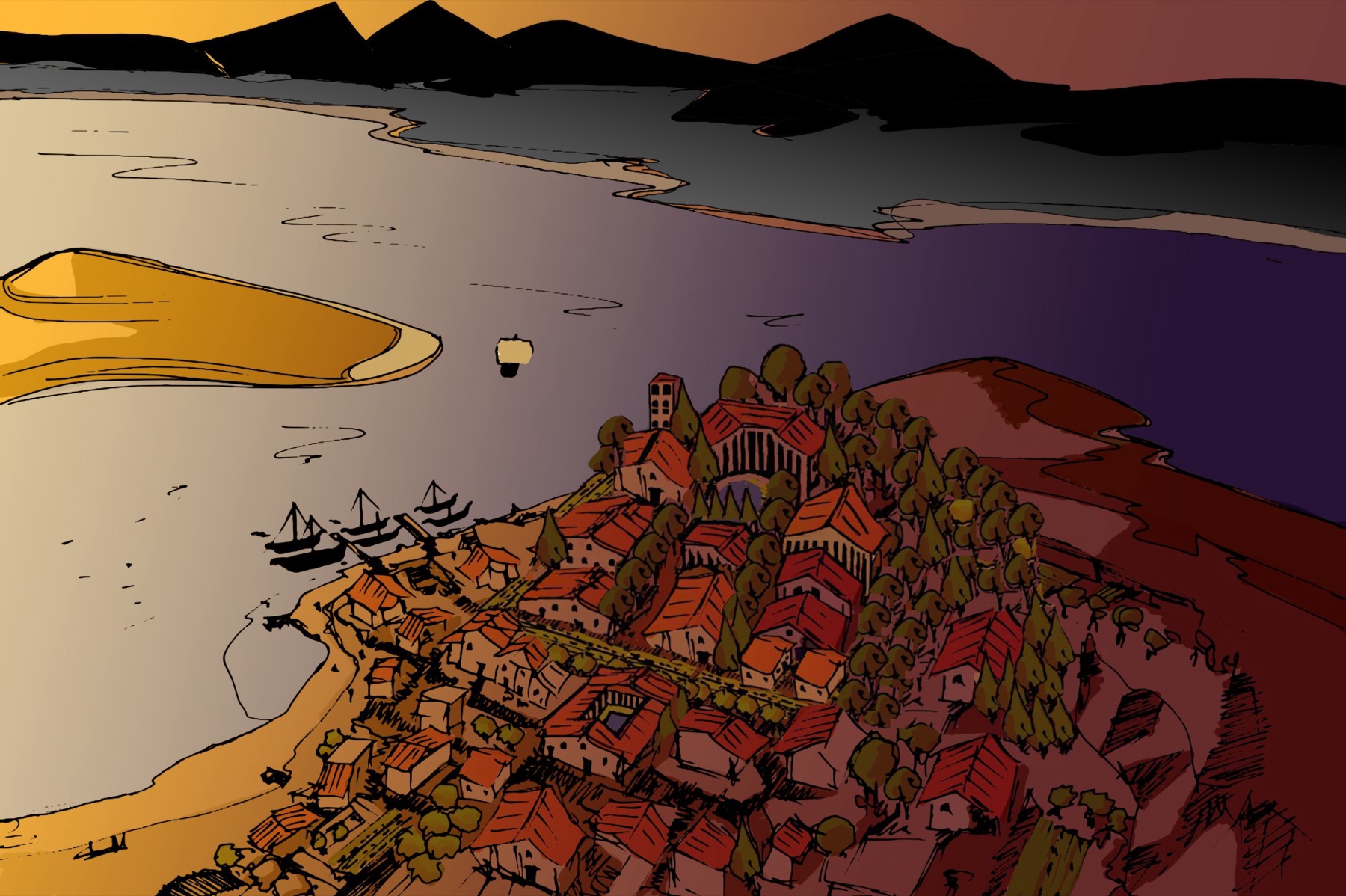
On the Gradina peninsula, above today's Hramina Bay, lay Colentum, one of the most important ancient towns of the Liburnian and Roman periods on the eastern Adriatic coast. Although much of the town has disappeared beneath the earth and the sea over the centuries, numerous historical records, archaeological finds and local legends still bear witness to its former importance.

A visit to Gradina today is not just a walk in nature with a view of the Kornati – it is a journey through more than two thousand years of history.

Ancient sources

Colentum in ancient records

The existence of Colentum is confirmed by three important ancient sources: the Roman writer Pliny the Elder, the Greek geographer and astronomer Claudius Ptolemy, and the author known as the Ravenna Cosmographer, writer of the late antique Cosmography.

All three place Colentum on an island in the southern part of Liburnia, i.e. in the area of today's northern Dalmatia.

Ancient sources

Ptolemy's Kollenton

In the 2nd century, Ptolemy mentions the town of Kollenton, located on one of the Liburnian islands off the southern part of their coast. His geographical data point precisely to the area of Murter.

Ancient sources

Pliny's precision

Pliny the Elder states that Colentum was located 30 Roman miles from Zadar (Iader) and 18 miles from the mouth of the river Krka (Titius).

Historian Slobodan Čače points out that these distances are almost unbelievably precise:

Assuming that Colentum is Gradina on Murter, these distances are measured with confusing precision, rivalling those in modern nautical distance tables.

— Slobodan Čače

These very data are among the strongest evidence that ancient Colentum was located in the area of today's Gradina and Hramina.

Travellers and chroniclers

Ivan Lučić – an island of plenty

The Croatian historian Ivan Lučić wrote:

Colentum, which sailors call Murter, is very rich in grain and wine and greatly abundant in liqueurs.

This record testifies to the island's long tradition of agriculture, winegrowing and abundance.

Travellers and chroniclers

Juraj Šižgorić – traces of an ancient town

As early as 1487, the Šibenik humanist Juraj Šižgorić noted:

The island called Murter near Lopsica is larger and fertile, and on it there are traces of a very old town. There are precious stones with signs and coins with Roman faces.

His record is one of the earliest testimonies of the ancient remains of Colentum.

Travellers and chroniclers

Dinko Zavorović – testimony of rich finds

At the end of the 16th century, the Šibenik chronicler Dinko Zavorović recorded that the following had been found on Gradina:

  • Roman inscriptions,
  • stone columns and sculptures,
  • coins of copper, silver and gold,
  • urns with ashes,
  • oil lamps (lucernae),
  • vaulted tombs and human remains.

Zavorović also mentions the funerary inscription of the Roman Julii family, which was later moved to Šibenik.

Travellers and chroniclers

Alberto Fortis – the travel writer who searched for Colentum

The Italian naturalist and travel writer Alberto Fortis visited Murter in 1774. Although he could no longer see the great ancient town, he wrote:

The only traces of the ancient settlement are some old tiles, fragments of vases and some carved stones.

Fortis states that coins and inscriptions were often found at the site and relates the tradition that the remains of the walls from the top of Gradina were used to build the church of Our Lady of Gradina.

Archaeology

Archaeological research and valuable finds

Over the centuries, numerous objects have been found in the area of Colentum that confirm the existence of a developed Roman settlement:

  • Roman coins of the emperors Nero and Vespasian,
  • bricks stamped by the Salonas and Pansiana workshops,
  • jewellery and decorative stone elements,
  • sarcophagi and cinerary urns,
  • oil lamps (lucernae),
  • inscriptions of Roman families,
  • remains of Roman buildings and tombs.

Particularly interesting is the structure known as “Tamnica” (the Dungeon), a 1st-century tomb with a barrel vault, which still arouses visitors' curiosity today.

Memories and legends

Luka Jelić – recorder of memories and legends

At the beginning of the 20th century, the archaeologist Luka Jelić systematically surveyed the area of Murter and recorded the remains of:

  • walls on land and in the sea,
  • sarcophagi and graves,
  • the sunken Roman shoreline,
  • the remains of the acropolis at the top of Gradina.

Jelić also wrote down the legends of the local people:

The villagers talk a lot about Gradina. According to them, Jews and Greeks came looking for treasure.

According to the stories, a golden horn was also found on Gradina, and the locals believed that old Roman graves lay beneath today's cemetery.

Memories and legends

Veljko Paškvalin – guardian of Murter's heritage

A special place in the study of Colentum belongs to the archaeologist and historian Veljko Paškvalin.

Paškvalin recorded the remains of medieval walls on Gradina, information about old excavations and local legends. He mentions the discovery of a mysterious “gilded angel” about 15 centimetres tall, found at the beginning of the 20th century by local resident Jure Jadrešin Bajok.

He also recorded the discovery of bones, scissors and other objects that fired the imagination of the inhabitants and gave rise to many stories about the hidden secrets of Gradina.

His records are precious because they link scientific research with Murter's oral tradition.

Literature

A poet's view of Gradina

The writer and diplomat Ante Tresić Pavičić describes Gradina in his poem “From the Hill of St Roch”:

And next to it is Gradina, a lush green peninsula, where an ancient manor once stood.

— Ante Tresić Pavičić

His verses still faithfully convey the beauty of the landscape surrounding the ancient site.

Colentum today

Colentum today

Today only parts of the former town are visible on Gradina, but every stone and every fragment tells a story of life here almost two thousand years ago.

Walking around Gradina and Hramina Bay, you can imagine Roman ships in the harbour, the town walls, luxurious houses and the everyday life of the people of Colentum.

The combination of natural beauty, archaeological heritage and numerous legends makes Colentum one of the most interesting historical sites on the island of Murter.